Father and Newborn Bonding Activities: Simple Ways to Build a Strong Connection


Bonding with your newborn doesn’t have to begin with one magical moment. For many dads, the connection grows gradually through the ordinary things they do with their baby every day.
Holding your newborn against your chest, changing a diaper, talking during a feed, soothing them when they cry, or reading a story they cannot yet understand may seem simple. But these repeated interactions give your baby opportunities to become familiar with your voice, touch, smell, and presence—and give you opportunities to become more confident in understanding their cues.
The best father and newborn bonding activities are therefore rarely elaborate. They are safe, responsive, everyday moments that allow you and your baby to spend time together.
Here are 12 practical ways to start building that connection from the newborn stage.
Why Father-Newborn Bonding Matters
Bonding helps create an emotional connection between a father and his baby, but it also has a practical side: the more time you spend caring for your newborn, the more opportunities you have to learn how they communicate.
You may begin recognizing the movements they make when they are tired, the sounds that come before a cry, how they like to be held, or what tends to calm them.
Your baby, meanwhile, experiences your voice, touch, smell, facial expressions, and the way you respond to their needs.
Bonding also gives dads a chance to become active, confident caregivers rather than feeling as though they are standing on the sidelines.
Father involvement continues to matter well beyond the newborn months. If you’d like to explore the bigger picture, our Fatherhood Matters guide explains why an engaged father’s presence can be important throughout a child’s life.
When Do Babies Start Bonding With Their Dads?
There isn’t a particular day when a newborn suddenly becomes “bonded” to dad.
Bonding is better understood as a developing relationship rather than a single event. The American Academy of Pediatrics explains that bonding is a gradual process that unfolds over time, as parents and babies become familiar with one another.
Research also suggests that babies begin learning voices before birth, so a newborn may already have some familiarity with frequently heard voices.
However, don’t use your baby’s visible reaction as a test of your relationship.
A newborn may settle more easily with one parent, cry when another person picks them up, or appear particularly interested in whoever feeds them most often. Hunger, tiredness, feeding, comfort, and familiarity can all affect how a newborn responds at a particular moment.
And if your partner is breastfeeding, that doesn’t put you at a bonding disadvantage. Feeding is only one of many ways babies experience responsive care.
The important thing is to keep participating.
12 Father and Newborn Bonding Activities
You don’t need special toys, expensive equipment, or a complicated bonding schedule. Start with the caregiving moments that already happen throughout your baby’s day.
1. Have Skin-to-Skin Time

Skin-to-skin contact isn’t only for mothers. The American Academy of Pediatrics notes that fathers and partners can take part in skin-to-skin care, giving newborns another opportunity for close contact with a caregiver.
When your baby is awake and you are alert, you can place your diapered newborn against your bare chest while supporting them securely. Choose a comfortable position where you can remain fully attentive to your baby.
Instead of treating skin-to-skin as something you need to “complete” for a certain number of minutes, think of it as an opportunity for calm, close contact.
Your newborn can experience your warmth, smell, heartbeat, voice, and touch while you get uninterrupted time together.
You might quietly talk, hum, or simply sit with your baby.
Safety note: Skin-to-skin should be supervised appropriately, and an adult who may fall asleep should not continue holding a newborn in an unsafe sleep position. If you become sleepy, move the baby to their own safe sleep space.
2. Hold and Cuddle Your Newborn
You don’t have to wait until your baby needs soothing to pick them up.
Cuddling can naturally fit around feeding, burping, waking, diaper changes, or quiet periods when your newborn is alert.
Support your baby’s head and neck carefully and experiment with safe, comfortable ways of holding them. Over time, you may discover that your baby seems particularly comfortable against your chest, over your shoulder, or cradled in your arms.
Try not to judge the success of a cuddle by whether your newborn stares at you or immediately relaxes.
Sometimes bonding looks like a peaceful baby.
Sometimes it looks like holding a crying baby while calmly staying present.
Both are opportunities to learn about each other.
3. Talk to Your Baby
What do you say to someone who can’t talk back?
Anything.
You can narrate what you’re already doing:
“Let’s get you into a clean diaper.”
“We’re going downstairs now.”
“That’s one tiny sock. Where’s the other one?”
“I’m making breakfast while you supervise.”
Your newborn doesn’t need to understand the words for talking to be worthwhile. Hearing your voice repeatedly gives them another familiar part of everyday life.
Try talking when your baby is quietly alert and watch their reactions. You might notice them becoming still, moving their eyes, changing their facial expression, or turning toward sound.
Don’t feel pressured to maintain a constant stream of “baby talk,” either. Natural conversation is enough.
4. Read to Your Newborn

Your newborn has absolutely no idea what happens at the end of the story.
Read it anyway.
At this age, reading together is less about understanding the plot and more about creating a calm interaction involving your voice, closeness, and attention.
Choose a short children’s book, nursery rhyme, poem, or even something you enjoy reading yourself.
You could make one small book part of your evening routine:
Fresh diaper → cuddle with dad → short book → settling for sleep.
As your baby grows, the meaning of reading together will change. But beginning early gives you a simple ritual that can grow with your child.
5. Sing or Hum to Your Baby
You do not need a good singing voice to sing to your newborn.
Your baby isn’t judging your pitch.
Try a lullaby, a song you like, a nursery rhyme, or a tune you make up while walking around the room. If singing feels awkward, simply hum.
Repeating the same song can eventually make it part of your own dad-and-baby routine.
You might sing while:
- changing clothes,
- carrying your baby around the house,
- settling them,
- cuddling after a feed, or
- getting ready for bed.
Keep the volume comfortable for your baby’s sensitive ears.
The purpose isn’t to entertain your newborn with a performance. It’s another gentle way to combine your voice, attention, and presence.
6. Take Part in Feeding
Feeding can create plenty of opportunities for dads to be involved, regardless of how a family feeds its baby.
If your baby is bottle-fed, you may be able to take responsibility for some feeds. Hold your baby securely, pay attention to their feeding cues, and follow the feeding advice you’ve received from your baby’s healthcare professional.
If your partner is breastfeeding, you still have an important role.
You can:
- bring the baby to your partner,
- help make your partner comfortable,
- handle a diaper change,
- burp the baby afterward,
- cuddle or settle the baby after the feed, or
- take responsibility for another part of the feeding routine.
This is especially helpful because bonding shouldn’t be reduced to who provides the milk.
What matters is that you repeatedly participate in meeting your baby’s needs.
7. Become the Burping Expert
Burping may not sound like a bonding activity, which is exactly why it belongs on this list.
Newborn bonding often happens through caregiving rather than “activities” in the traditional sense.
If your baby needs burping after a feed, make it one of the tasks you regularly take on.
Hold your baby securely against your chest or shoulder using an appropriate burping position, support them properly, and gently pat or rub their back.
It’s a small job, but it gives you repeated close-contact time.
You may also begin learning little details that build caregiving confidence: whether your baby usually burps quickly, likes a particular position, becomes sleepy afterward, or needs a few quiet minutes before settling.
Follow your healthcare professional’s advice if your baby has feeding difficulties, frequent vomiting, poor weight gain, significant discomfort, or another medical concern rather than trying to solve it through burping techniques alone.
8. Change Diapers and Help With Dressing
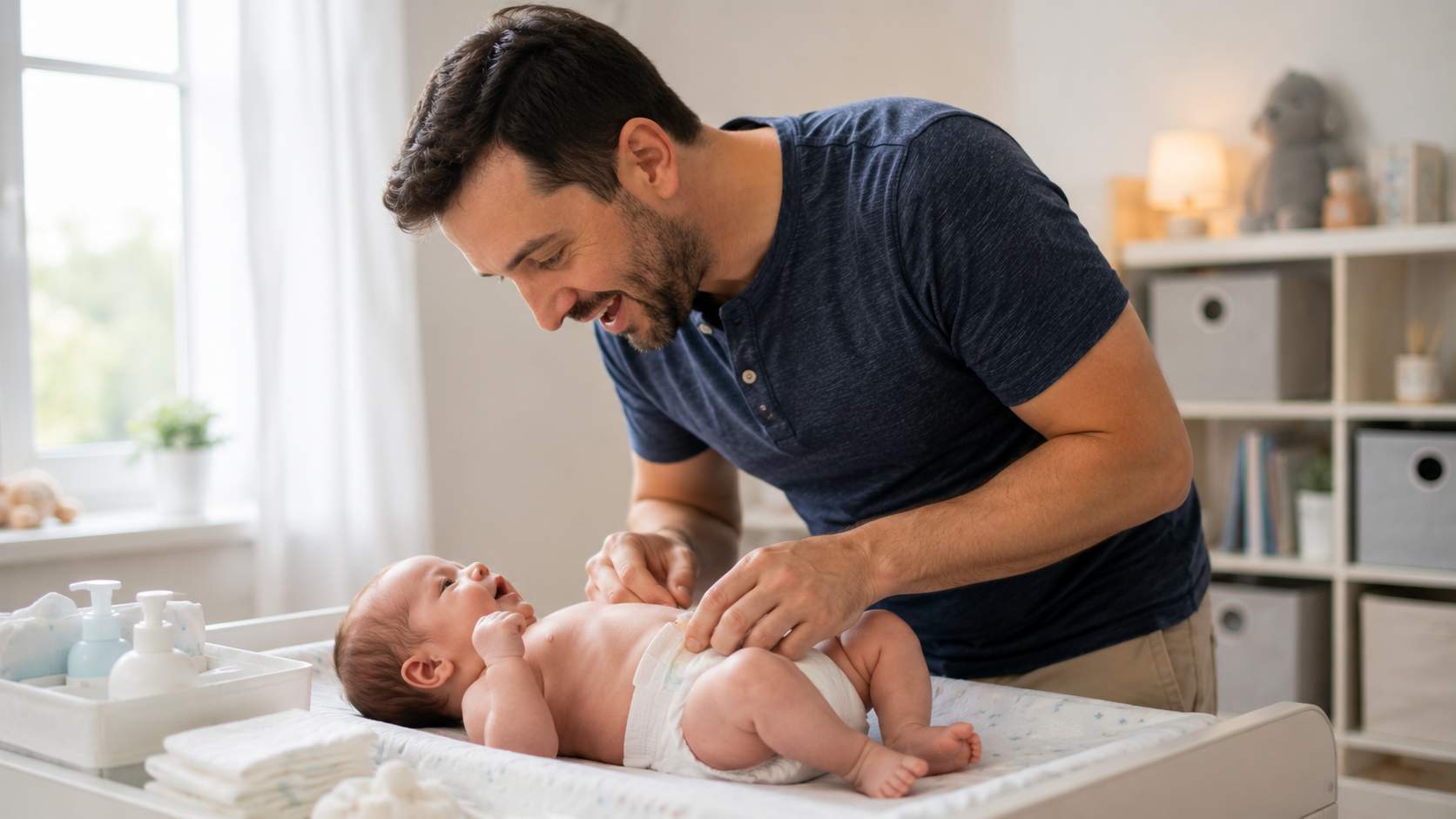
Don’t underestimate the bonding potential of the changing table.
Newborns need frequent diaper changes, which means this routine creates many opportunities for short one-on-one interactions.
Instead of approaching every change as a race against the next cry, slow down when circumstances allow.
Talk about what you’re doing. Make gentle eye contact when your baby is receptive. Smile back at their expressions. Let them hear your voice as you put on clean clothes.
You could make the first morning diaper change “dad’s job” or take over changes when you’re home from work.
There is an important practical benefit too: the more everyday care you handle, the less intimidating solo caregiving tends to feel.
A strong father-baby relationship isn’t built only during picture-perfect cuddles. It’s also built at 2 a.m. with a clean diaper in one hand and a tiny pair of pajamas in the other.
9. Help With Bath Time
Bath time can provide close, focused interaction—but with a newborn, safety matters much more than making the bath a bonding experience.
Depending on your baby’s age and circumstances, your healthcare team may advise when and how to begin bathing. Until then, appropriate sponge cleaning may be recommended.
When baths become part of your routine, dad can take responsibility for preparing supplies, bathing, drying, dressing, or cuddling afterward.
Have everything you need within reach before you start.
Most importantly, never leave your baby alone in the bath, even for a second. The NHS emphasizes that babies require continuous adult supervision during bath time.
If you need to leave the bathing area, take your baby with you.
Once the safety basics are handled, bath time can become another familiar routine where your baby hears your voice and experiences your calm touch and attention.
10. Soothe and Settle Your Baby

When a newborn cries, dad doesn’t always need to immediately hand the baby to mom.
First consider what your baby might need.
Are they hungry? Wet? Tired? Too warm or cold? Overstimulated? In need of closeness?
When feeding isn’t the immediate need, you can try safely holding your baby, walking slowly, gently rocking, speaking quietly, humming, or using another settling method appropriate for your baby’s age.
The goal isn’t to discover a secret dad technique that stops every cry.
Sometimes nothing you try will produce an instant result.
Responding calmly still matters.
Over time, you may develop your own settling rhythm with your baby. Perhaps they relax against your chest while you walk or become calmer when you hum the same song.
If crying is unusual, persistent, accompanied by signs of illness, or you’re concerned about your baby’s wellbeing, seek appropriate medical advice.
And if you ever feel overwhelmed by crying, place your baby safely in their cot or other appropriate safe sleep space and give yourself a brief opportunity to regain composure. Never shake a baby.
11. Go for a Walk Together

Once walking outside is appropriate for your baby and circumstances, a short walk can give you valuable one-on-one time.
You might use a suitable stroller or an age-appropriate baby carrier that is correctly fitted and used according to its instructions.
A walk doesn’t need to be an expedition.
Ten or fifteen minutes around your neighborhood may be enough to give you time away from household distractions.
Talk to your baby as you walk. Tell them where you’re going. Point out completely ordinary things they cannot yet understand.
“That’s the park.”
“There’s a very loud dog.”
“We’re heading home now.”
For working dads, a weekend morning walk can eventually become a particularly useful recurring ritual.
When using a sling or carrier, keep your baby’s airway clear and make sure their face remains visible. The NHS recommends following the TICKS rule for safer babywearing: Tight, In view at all times, Close enough to kiss, Keep chin off the chest, and Supported back.
12. Create a Simple Dad-and-Baby Routine
Of all the bonding ideas in this article, this may be the easiest to sustain.
Choose one or two parts of the day that you can regularly share with your baby.
For example:
Morning: Dad handles the first diaper change and cuddle.
After work: Ten minutes of holding, talking, or walking around together.
Evening: Dad changes pajamas and reads a short story.
Bedtime: Dad helps with settling when appropriate.
You don’t need all four.
One dependable routine is better than an ambitious bonding schedule that lasts three days.
Consistency gives you repeated opportunities to notice your baby’s cues and become more comfortable responding to them. It also makes bonding part of family life instead of another item on your new-parent checklist.
The habits you establish now can evolve as your child grows—from newborn cuddles to floor play, bedtime stories, conversations, and shared activities.
That kind of responsive, everyday involvement is also a foundation for the Positive Parenting Tips for Fathers we use as children move beyond the newborn stage.
Bonding Activities for Dads Who Work During the Day

Working outside the home doesn’t mean you need hours of uninterrupted baby time to build a relationship.
Look for small routines you can realistically repeat.
Before work, you might handle a diaper change, cuddle your baby after an early feed, or spend a few quiet minutes talking to them.
When you return home, consider taking responsibility for one predictable caregiving task such as:
- an evening diaper change,
- burping after a feed,
- bath time when appropriate,
- a short book,
- an evening cuddle, or
- helping settle your baby.
Weekends may provide opportunities for longer one-on-one periods, such as a stroller walk or taking over part of the morning routine while your partner rests.
Try not to compensate for limited weekday time by inventing elaborate “quality time.”
For a newborn, being consistently involved in ordinary care is meaningful. For a newborn, being consistently involved in ordinary care is meaningful. As your child grows, bonding becomes less about newborn care and increasingly about listening, conversation and shared trust; our guide to father-child communication explains how to maintain that connection through later childhood and the teenage years.
What If Your Newborn Seems to Prefer Mom?
It can sting when you’ve spent ten minutes trying to settle your baby and they calm almost immediately when mom takes over.
Don’t interpret one of these moments as a verdict on your relationship.
A newborn may appear to prefer one caregiver at particular times because that person is associated with feeding, has been providing more of their care, or simply feels most familiar in that moment. A hungry breastfed baby, for example, may have a very practical reason for wanting mom.
Tiredness, hunger, overstimulation, smell, voice, position, and routine can all influence how a baby responds.
Instead of competing with your partner, keep building familiarity.
Change diapers. Hold your baby. Talk. Burp them. Take walks. Help with baths. Settle them when you can.
And give yourself opportunities to care for your baby when they’re relatively calm—not only when they’re already exhausted and crying.
Most importantly, don’t force interaction in an attempt to prove that your baby can settle with you.
Keep showing up.
What If You Don’t Feel an Instant Bond With Your Baby?
Not every father experiences an overwhelming rush of connection the first time he holds his newborn.
You may feel love immediately but not yet feel like you know your baby. You may feel protective but awkward. You may even feel surprisingly detached while adjusting to disrupted sleep, new responsibilities, changes in your relationship, and the reality of caring for another person.
A developing bond is not a parenting failure.
Give the relationship something to grow through.
Take part in feeds where appropriate. Change diapers. Hold your baby. Learn their cues. Spend time alone with them. Build a small routine that belongs to the two of you.
Try not to compare your emotions with your partner’s experience or another dad’s story.
If you’re still finding your feet in the wider transition to fatherhood, our First-Time Dad Guide covers the practical and emotional adjustment that comes with becoming a new father.
There is, however, an important distinction between a bond that is developing gradually and persistent emotional difficulties that are affecting your wellbeing or ability to function.
Fathers can experience depression, anxiety, and other mental-health difficulties during the perinatal period too. If you experience persistent low mood, intense anxiety, hopelessness, withdrawal, difficulty functioning, frightening thoughts, or other symptoms that concern you, speak with a qualified healthcare professional rather than assuming you simply need to “try harder” to bond.
Father-Newborn Bonding Mistakes to Avoid
Bonding is not a performance, so avoid turning every interaction into a test of whether your baby likes you yet.
Common mistakes include:
- Expecting an immediate response. Newborns aren’t going to reward every interaction with smiles and obvious affection.
- Giving up when mom settles the baby faster. Familiarity grows through repeated care.
- Only doing the enjoyable jobs. Diapers, burping and settling count just as much as cuddles.
- Forcing interaction. Pay attention to your baby’s cues and give them a break when they seem tired or overstimulated.
- Comparing relationships. Your baby’s relationship with you doesn’t need to look identical to their relationship with your partner.
- Taking unsafe shortcuts. Never compromise safe sleep, bathing, carrying, or handling practices to create closeness.
- Treating bonding as a deadline. Relationships develop over time.
Focus less on measuring the bond and more on becoming a familiar, responsive caregiver.
How Partners Can Encourage Father-Baby Bonding
Partners can help create space for fathers to become confident caregivers rather than positioning dad as an assistant who only steps in when asked.
When practical, let dad take responsibility for complete routines—perhaps a diaper change, bath, post-feed settling, or morning cuddle—rather than only completing small pieces under constant direction.
It’s also helpful to accept that two capable parents may perform ordinary caregiving tasks slightly differently.
Safety requirements are non-negotiable, of course. But when both approaches are safe, dad doesn’t necessarily need to hold, dress, soothe, or talk to the baby exactly as mom does.
That space allows father and baby to develop their own rhythm.
Safety Comes Before Bonding Activities
Newborns are physically vulnerable, so every bonding activity should be adapted to your baby’s age, health, and developmental needs.
Keep these fundamentals in mind:
- Support your newborn’s head and neck when holding and repositioning them until they have sufficient control.
- Follow safe-sleep guidance. The CDC recommends placing babies on their backs for every sleep on a firm, flat sleep surface. Bonding through cuddling should never lead to leaving a newborn asleep in an unsafe position or environment.
- Never leave a baby unattended in water. Prepare everything before bath time and maintain constant supervision.
- Use carriers correctly. Choose an appropriate product and follow its age, weight, fit, positioning, and airway instructions.
- Never shake a baby. If crying becomes overwhelming, put your baby safely down in an appropriate place and step away briefly to regain control.
- Follow individualized medical advice. Premature babies and newborns with medical or feeding concerns may require different handling, feeding, positioning, or activity guidance.
For safe sleep, bathing, feeding, crying, and other newborn-care questions, use current guidance from your pediatrician or qualified healthcare professional and trusted health authorities such as the American Academy of Pediatrics, CDC, NHS, or your country’s public-health service.
Bonding should always happen within safe newborn care—not instead of it.
Frequently Asked Questions
How can a father bond with a newborn?
Start by becoming actively involved in ordinary care. Hold your baby, have safe skin-to-skin contact, talk and sing to them, change diapers, participate in feeding routines, burp them, help with bathing, soothe them, read aloud, and create one or two consistent dad-and-baby routines.
You don’t need to make your newborn respond in a particular way. Repeated, responsive interaction is more important than elaborate activities.
How long does it take for a dad to bond with his baby?
There is no standard bonding timeline. Some fathers feel strongly connected immediately, while others develop that feeling gradually over days, weeks, or longer as they care for and get to know their baby.
Rather than setting yourself a deadline, focus on regular involvement and seek professional support if emotional difficulties are persistent or affecting daily functioning.
Can a newborn recognize their father’s voice?
Newborns can respond to familiar voices, and babies begin processing sounds before birth. If a father spoke regularly around the baby during pregnancy, his voice may already be familiar after birth.
After birth, regularly talking, reading, humming, and singing gives your newborn many more opportunities to experience your voice.
Can dads do skin-to-skin with newborns?
Yes. Fathers can have skin-to-skin contact with their newborns when it can be done safely. Dad can place the diapered baby against his bare chest while securely supporting the baby and remaining awake and attentive.
Follow your maternity or pediatric team’s advice if your baby was born prematurely, is medically unwell, or requires special care.
How can a dad bond with a breastfed baby?
Breastfeeding doesn’t prevent dad from forming a close relationship with the baby.
Dad can handle diaper changes, bring the baby for feeds, burp them afterward, cuddle and settle them, have skin-to-skin time, read and sing, help with baths, take walks, and establish his own regular caregiving routines.
Bonding involves far more than feeding.
What should I do if my baby only settles with mom?
First, don’t assume you’ve done something wrong.
Consider whether your baby is hungry, tired, overstimulated, or seeking a familiar feeding or soothing routine. Continue spending time with your baby when they’re calm as well as practicing appropriate soothing when they’re upset.
Let familiarity develop through repeated care rather than repeatedly forcing settling attempts when your baby is becoming increasingly distressed.
Small Moments Build Strong Bonds
You don’t need to manufacture extraordinary experiences to build a relationship with your newborn.
Father-newborn bonding happens in repeated ordinary moments: the diaper you change before work, the baby sleeping against your chest while you’re awake and attentive, the song you hum, the post-feed burp, the evening story, and the times you keep calmly trying to comfort them.
Some dads feel connected immediately. For others, the relationship develops quietly as confidence and familiarity grow.
Keep caring, responding, talking, holding, and showing up. Small, repeated moments of care are often where a strong father-baby bond begins.