
Father-Child Communication: How to Listen, Talk and Stay Connected as They Grow


Your child used to tell you everything.
Who sat next to them at lunch. What happened on the playground. Why they were angry with their best friend. The completely unnecessary details of a video they had already explained to you twice.
Then, somewhere along the way, the answers became shorter.
“How was school?”
“Fine.”
“Anything happened?”
“No.”
“Is something wrong?”
“I don’t know.”
For a father, that change can be confusing. You may wonder whether you should ask more questions, give your child space, offer advice, or sit them down for a serious conversation.
Often, the answer is simpler:
Talk a little less. Make it easier for your child to talk a little more.
Good father-child communication isn’t measured by how many conversations you have or whether your child tells you everything. It’s built when your child learns, through hundreds of ordinary interactions, that Dad can listen without immediately judging, lecturing, dismissing or trying to fix everything.
That kind of everyday connection is part of the larger reason involved fatherhood matters throughout a child’s development, not only during the early years.
Research on parent-adolescent communication supports the importance of communication quality, including openness and fewer communication problems, rather than simply counting how often parents and children talk.
Here is how fathers can build that kind of relationship as their children grow.
Good Father-Child Communication Starts With Listening, Not Talking
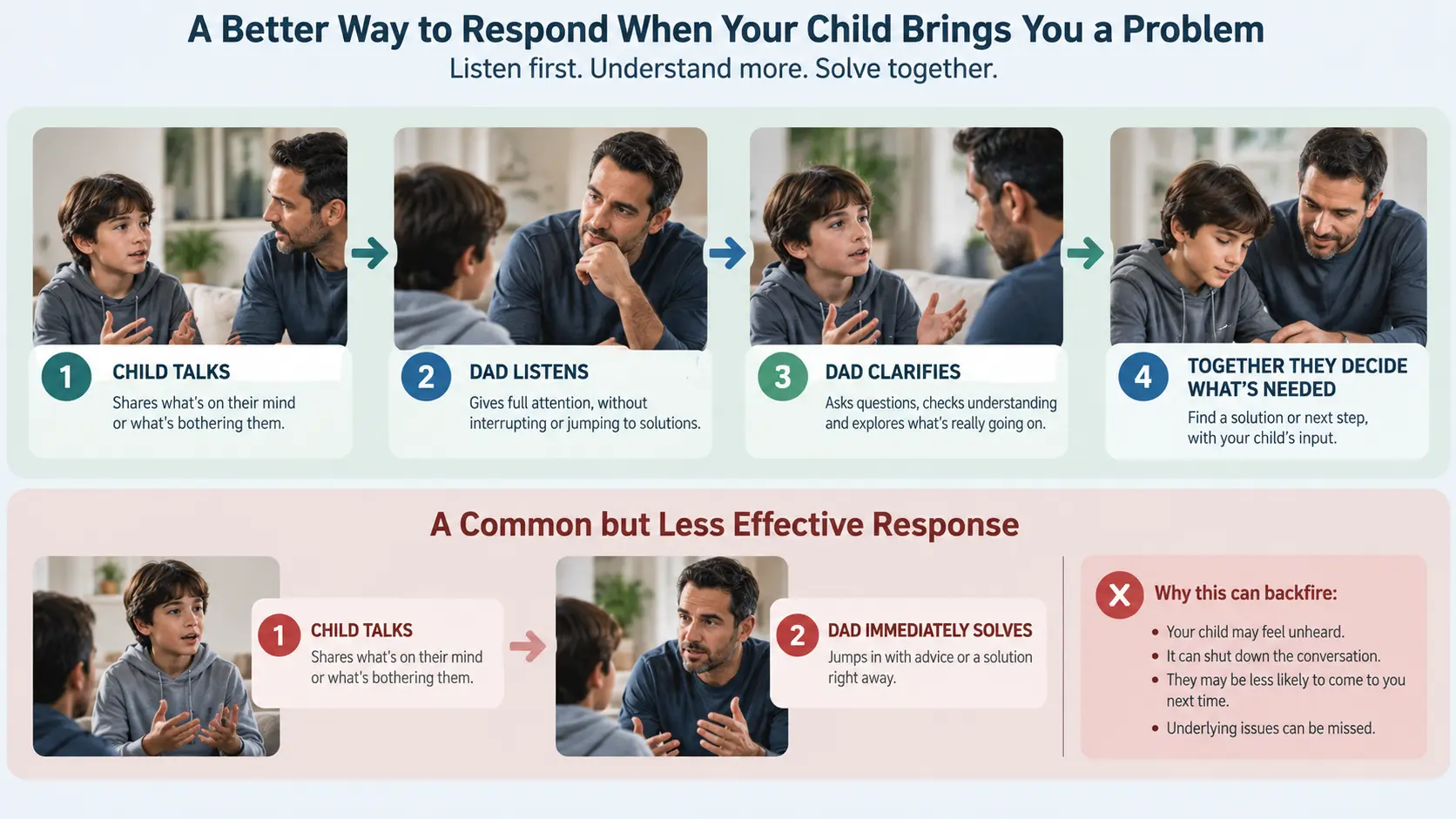
Listening first also fits a broader positive parenting approach for fathers: guide the child without making every difficult moment about control.
Many dads are natural problem-solvers.
Your child says, “My friend is ignoring me.”
Your brain immediately starts working:
Talk to another friend. Don’t let them treat you like that. Here’s what you should do tomorrow…
The advice may even be good.
But advice isn’t always what your child needs first.
Sometimes the problem they are bringing you is not actually the first problem to solve. The first problem is:
“Does Dad understand how this feels?”
Try listening until you understand the problem before deciding whether it needs a solution.
That can mean putting down your phone, allowing a pause instead of filling it, and asking one more question before offering an answer.
Active and reflective listening—showing attention and reflecting back what a child seems to be communicating—can help children feel heard and understood.
A surprisingly useful question is:
“Do you want me to just listen, or do you want help figuring out what to do?”
It gives your child some control over the conversation while keeping you involved.
Try changing the first response
| Instead of immediately saying… | Try starting with… |
|---|---|
| “That’s nothing to worry about.” | “You seem pretty worried about it.” |
| “Just ignore them.” | “What happened after they said that?” |
| “I told you this would happen.” | “Okay. Tell me what happened.” |
| “Here’s what you need to do.” | “Do you want ideas, or do you want me to listen first?” |
| “Why did you do that?” | “Help me understand what was going on.” |
This doesn’t mean agreeing with everything your child does.
Listening and approving are two different things.
You can fully hear your child and still disagree with their decision, enforce a boundary or give a consequence.
The order matters.
Understand first. Respond second.
Why Won’t My Child Talk to Me?
When a child stops opening up, fathers sometimes assume:
They’re becoming secretive.
They don’t need me anymore.
Teenagers are just like this.
Sometimes children do naturally become more private as they grow. But before blaming age, look at what usually happens after your child tells you something.
Imagine your child admits:
“I got in trouble at school today.”
What happens next?
If honesty consistently produces an instant lecture, angry interrogation or 20-minute speech, the child may eventually learn that saying less is easier.
The same thing can happen when every problem is minimized:
“You’ll get over it.”
Or immediately solved:
“Here’s what you’re going to do.”
Or turned into a lesson:
“When I was your age…”
None of those responses automatically makes someone a bad father. They often come from wanting to protect and guide a child.
But if you want more honest conversations, ask yourself an uncomfortable but useful question:
What does my child expect will happen when they tell me the truth?
That answer can tell you a lot about your communication.
Stop Turning Every Conversation Into an Interview
There is a familiar scene in many homes.
Dad wants to connect.
So Dad asks:
“How was school?”
“What did you do?”
“Who did you sit with?”
“Any homework?”
“What did your teacher say?”
“What’s wrong?”
“Why aren’t you talking?”
From Dad’s side, that’s interest.
From the child’s side, it can feel like an interview.
Try replacing a string of questions with one observation or invitation.
Instead of:
“How was school?”
you might try:
“You look exhausted today.”
Or:
“What was the weirdest thing that happened today?”
Or simply:
“Good to have you home.”
Then leave some space.
Not every opening needs to become a deep conversation.
In fact, one of the best ways to make children comfortable talking about big things is to keep talking about small things.
Some of the Best Conversations Don’t Look Like Conversations

You don’t necessarily need to announce:
“Son, we need to improve our communication.”
That sentence alone may make a teenager search for the nearest exit.
Connection often happens more naturally when you are doing something else together.
Try talking while:
- driving somewhere
- walking the dog
- making dinner
- shooting hoops
- fixing something
- doing household jobs
- getting a snack
- travelling
- sitting together after everyone else has gone to bed.
Side-by-side moments can remove some of the intensity of a face-to-face “talk.”
Don’t underestimate ordinary time.
Your child may say almost nothing during the first 20 minutes of a drive and then, just before you reach home:
“Dad, can I ask you something?”
That moment is why availability matters.
The Conversation Has to Grow Up With Your Child
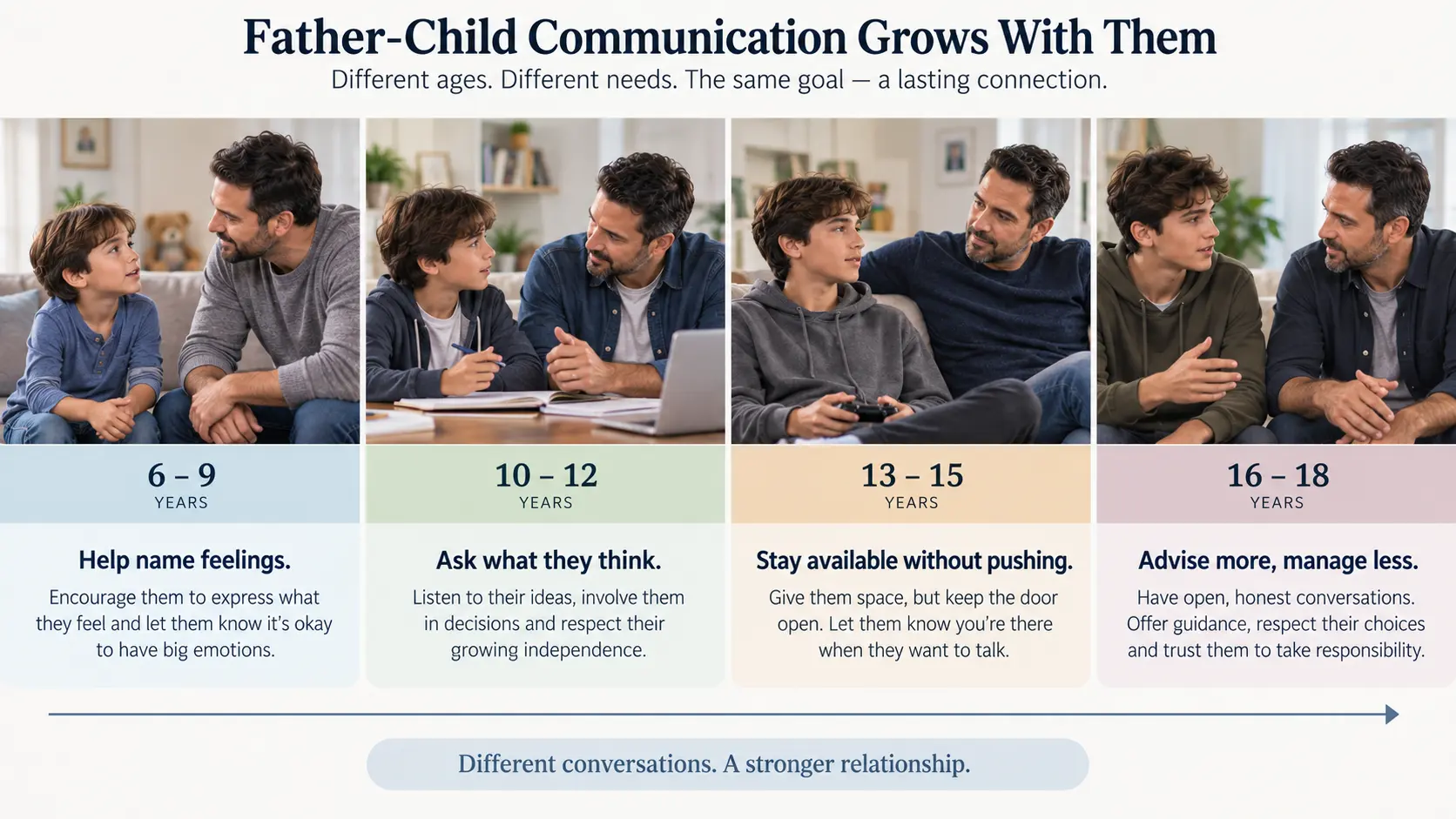
A communication style that works beautifully with a seven-year-old can feel controlling to a seventeen-year-old.
As children become more capable of forming their own views, handling relationships and making decisions, Dad’s role gradually changes too.
Ages 6–9: Help them put experiences into words
Children at this age may know something feels bad without being able to explain exactly why.
Instead of demanding an explanation, help them identify what happened.
You might ask:
“Were you more angry, embarrassed or sad?”
Keep questions concrete and manageable.
Give them your attention when they tell you seemingly tiny stories. Today’s story about playground drama may not matter much to you, but your response is teaching your child whether bringing things to Dad feels worthwhile.
Ages 10–12: Curiosity works better than interrogation
Children begin wanting more independence and privacy.
Your job isn’t to stop asking questions. It’s to ask them in a way that respects the person developing in front of you.
Try:
“What do you think?”
“What would you like to do?”
“Want to talk about it?”
You are beginning to shift from giving every answer to helping your child think.
Ages 13–15: Stay close without demanding access to everything
This can be a frustrating stage for dads.
Friends become enormously important. Privacy increases. Your teenager may be talkative one evening and almost impossible to reach the next.
Don’t interpret every closed bedroom door as rejection.
But don’t disappear either.
Continue inviting them into everyday life. Eat together when possible. Drive them places. Show interest in what they enjoy. Learn enough about their world that every conversation doesn’t begin with school performance.
Most importantly, don’t make emotional disclosure the price of spending time with Dad.
Your teenager should be allowed to simply be with you.
Ages 16–18: Become more adviser, less manager
Older teenagers need boundaries, but they also need opportunities to make decisions and experience appropriate consequences.
Instead of automatically announcing the answer, ask:
“What’s your plan?”
“What do you think could go wrong?”
“What are your options?”
“Want my opinion?”
Sometimes they will make a different decision from the one you would make.
That can be difficult.
But raising a capable young adult eventually requires allowing your child to practice thinking without Dad doing all the thinking for them.
When Your Child Tells You Something You Don’t Want to Hear
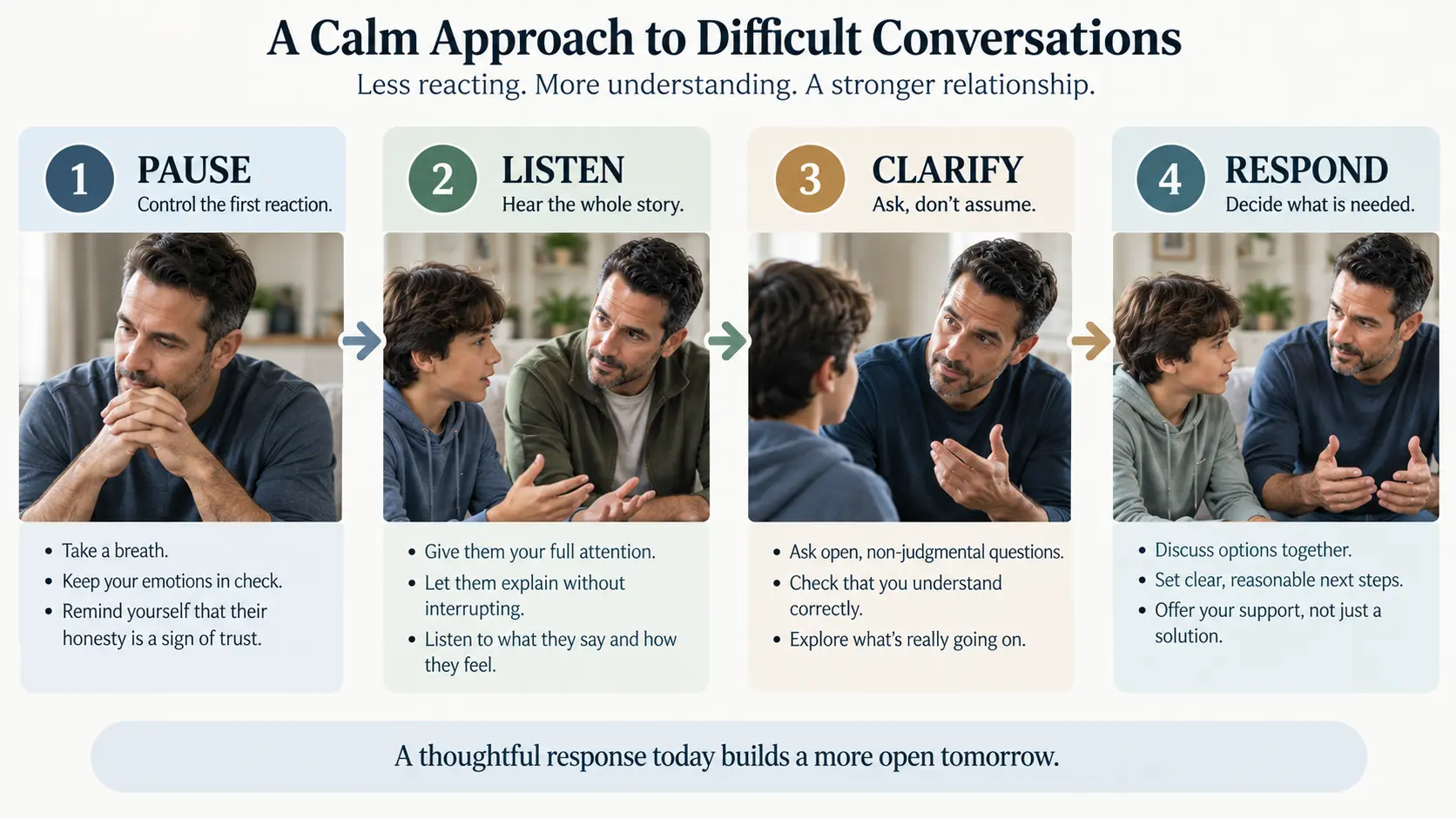
If the problem involves repeated bullying, deciding when a parent should step in when a child is bullied requires balancing listening with appropriate adult action.
This may be the most important communication test of all.
Your child tells you:
“I failed.”
“I lied.”
“I broke the rule.”
“Someone is bullying me.”
“I did something stupid.”
“I think I’m dating someone.”
“I sent something I shouldn’t have.”
“I don’t want to do what you want me to do.”
Your first emotion may be fear, disappointment or anger.
Your first response, however, doesn’t have to be your first emotion.
Use four steps:
1. Pause
You don’t have to react within three seconds.
2. Listen
Get the full story before deciding what the story means.
3. Clarify
Ask what happened rather than filling missing information with assumptions.
4. Respond
Now decide whether your child needs comfort, guidance, a boundary, a consequence, outside help—or some combination of them.
If the situation involves immediate safety, abuse, self-harm, violence or another serious danger, safety takes priority over preserving a comfortable conversation. Seek appropriate professional or emergency help when necessary.
But in ordinary difficult conversations, remember:
If telling you the truth took courage, don’t make honesty feel like the mistake.
You can deal firmly with the behaviour without punishing the act of coming to you.
“Fine” and “I Don’t Know” Aren’t Dead Ends
When your child repeatedly says “fine,” pushing harder often produces an even shorter answer.
Instead of asking broader questions, sometimes make them smaller.
Instead of: “How was your day?”
Try: “What was the best ten minutes of your day?”
Instead of: “What’s wrong?”
Try: “You seem quieter than usual. Rough day?”
Instead of: “How’s school?”
Try: “Which class is actually interesting at the moment?”
Instead of: “Why are you upset?”
Try: “Do you want company or some space?”
But don’t turn these into a new interrogation script.
Children notice techniques.
The goal isn’t to discover the perfect question that forces your child to talk.
The goal is to create enough low-pressure opportunities that talking becomes easier when they want to.
Talk About Difficult Things Before They Become Emergencies
Some subjects are awkward for fathers.
Sex. Relationships. Consent. Pornography. Alcohol. Drugs. Mental health. Bullying. Social media. Body image. Failure.
Avoiding them doesn’t make them disappear from your child’s life.
It simply increases the chance that someone else becomes their main source of information.
Research specifically examining fathers’ conversations with teenagers about sex and relationships found fathers used several ways to open these discussions—including personal experiences, examples involving other people, and situations from media or popular culture.
These conversations are also easier when fathers treat age-appropriate sex education as an ongoing part of parenting rather than one uncomfortable talk.
That offers dads a useful principle:
You don’t always need to start with “We need to talk about you.”
A scene in a film, something in the news, a friend’s situation or a social-media story can create a less threatening opening:
“What do you think about that?”
Then listen to the answer.
When discussing sensitive subjects, resist turning the conversation into a single giant lecture designed to cover everything your child needs to know until age 25.
Several smaller conversations usually leave more room for questions, changing maturity and real-life situations.
For topics such as sex education, bullying or online safety, use the conversation to open the door and then give your child accurate, age-appropriate information rather than relying on fear or shame.
Don’t Let Stereotypes Decide How You Talk to Your Son or Daughter
Fathers can fall into two traps:
“Boys don’t want to talk about feelings.”
and
“I don’t know how to talk to my daughter about this.”
Neither is a good communication strategy.
Your son’s personality matters more than a stereotype about boys. Your daughter’s individual needs matter more than a stereotype about girls.
Research does suggest father-teen communication can differ depending on the child’s gender and subject being discussed, including conversations about sex and relationships.
That is a reason for fathers to become more comfortable and capable, not a reason to withdraw from subjects that feel unfamiliar.
Let your actual child teach you how they communicate.
One child talks immediately.
Another needs an hour.
One talks while walking.
Another sends you a message from the bedroom upstairs.
One wants advice.
Another wants you to listen.
Fair parenting does not require identical conversations with every child.
What If You and Your Child Keep Arguing?
Conflict doesn’t automatically mean your relationship is damaged.
Families disagree.
What matters is what happens during and after the disagreement.
A useful rule for fathers is:
Don’t confuse winning the argument with solving the problem.
If both of you are shouting, sarcasm is taking over and nobody is listening, continuing the conversation may accomplish nothing.
You can say:
“We’re both too angry to do this properly. We’ll come back to it.”
And then actually come back.
That last part matters.
Taking a break is different from shutting your child out.
When you return, avoid insults, humiliation, bringing up every past mistake or attacking your child’s character.
Compare:
“You’re irresponsible.”
with:
“You agreed to be home at ten and came home at eleven without contacting us. That’s the problem we need to deal with.”
One labels the child.
The other addresses the behaviour.
Research continues to examine how communication and conflict-management interventions affect mother-adolescent and father-adolescent communication; a randomized family study published in 2025 found some improvements in father-adolescent communication measures when both parents and adolescents participated.
In practical terms: communication is a skill a family can work on. A difficult pattern does not have to become the permanent pattern.
Dads Are Allowed to Apologize
You will get conversations wrong.
You will overreact.
You will misunderstand something.
You will occasionally give a speech that should have ended 14 minutes earlier.
Being Dad doesn’t require pretending otherwise.
Try:
“I was right to address what happened, but I wasn’t right to shout at you.”
Or:
“I didn’t listen properly earlier. Can we start again?”
An apology does not erase a boundary.
It demonstrates something more valuable: adults are responsible for how they communicate too.
That is a lesson children can eventually carry into friendships, work, marriage and parenting of their own.
When Your Teen Barely Talks to You
There may come a period when you do almost everything “right” and your teenager still doesn’t say much.
Don’t panic and don’t force intimacy.
Give space without disappearing.
Keep showing up.
Invite them for food.
Drive them.
Ask occasionally—not constantly—about what matters to them.
Send the funny video.
Watch the game.
Make the terrible dad joke.
Know their friends’ names.
Say goodnight.
Be interested without monitoring every detail.
And when they unexpectedly begin talking at 11:37 p.m. on a night when you desperately want to sleep?
When possible, stay awake a little longer.
You may not get to choose when an older child decides the door is open.
Seven Habits That Make Dad Easier to Talk To
You don’t need a perfect communication technique. Start with these:
- Listen to the whole story before solving it.
- Keep your first reaction under control when honesty is uncomfortable.
- Ask questions because you’re curious, not because you’re building a case.
- Make ordinary time together instead of waiting for serious conversations.
- Respect age-appropriate privacy while remaining involved.
- Return after arguments and repair what needs repairing.
- Let your child disagree with you without treating disagreement as disrespect.
These habits won’t make every conversation easy.
They do something more useful:
They make the next conversation more likely.

The Goal Isn’t a Child Who Tells Dad Everything
Your child is supposed to develop a private inner life.
They will have thoughts they don’t share with you.
They will tell friends things first.
They may make decisions without asking Dad.
Growing independence isn’t proof that you’ve lost your connection.
The better measure of father-child communication is what happens when something really matters.
When your child is scared.
When they’ve made a mistake.
When they don’t know what to do.
When they need someone who will tell them the truth without making them feel small.
You don’t need your child to think:
“Dad always has the answer.”
A far more valuable relationship is one in which, years from now, they still know:
“I can talk to Dad.”
